Test Sieves Manufacturer India
Test Sieves: Complete Guide to Types, Sizes, Uses & Sieve Analysis in Civil Engineering
Test Sieves are one of the most important laboratory testing instruments used in civil engineering, construction, mining, pharmaceuticals, agriculture, and material testing laboratories. They play a vital role in determining the particle size distribution of aggregates, sand, soil, cement, minerals, chemicals, and other granular materials. Accurate sieve analysis helps engineers maintain quality standards and ensures that construction materials meet project specifications.
Whether you are working in a quality control laboratory, educational institution, research center, or construction project, selecting the right Test Sieves is essential for obtaining reliable and repeatable test results.
This guide explains everything you need to know about Test Sieves, including their types, standard sizes, applications, benefits, maintenance, and how to choose the right sieve for your laboratory.
What Are Test Sieves?
A Test Sieve is a precision-engineered laboratory instrument consisting of a metal frame and a woven wire mesh or perforated plate with accurately controlled openings. During testing, materials are placed on the sieve and shaken either manually or with a sieve shaker. The particles are separated according to size, making it possible to determine the grading of the sample.
Test Sieves are manufactured according to internationally recognized standards such as IS, ASTM, ISO, and BS, ensuring accurate and consistent results
Why Are Test Sieves Important?
Accurate particle size analysis is essential for producing quality construction materials. Test Sieves help engineers verify whether materials comply with project specifications and industry standards.
Some major advantages include:
- Accurate particle size distribution
- Reliable laboratory testing
- Consistent quality control
- Compliance with IS and ASTM standards
- Better construction performance
- Improved research accuracy
- Repeatable test results
- Reduced material wastage
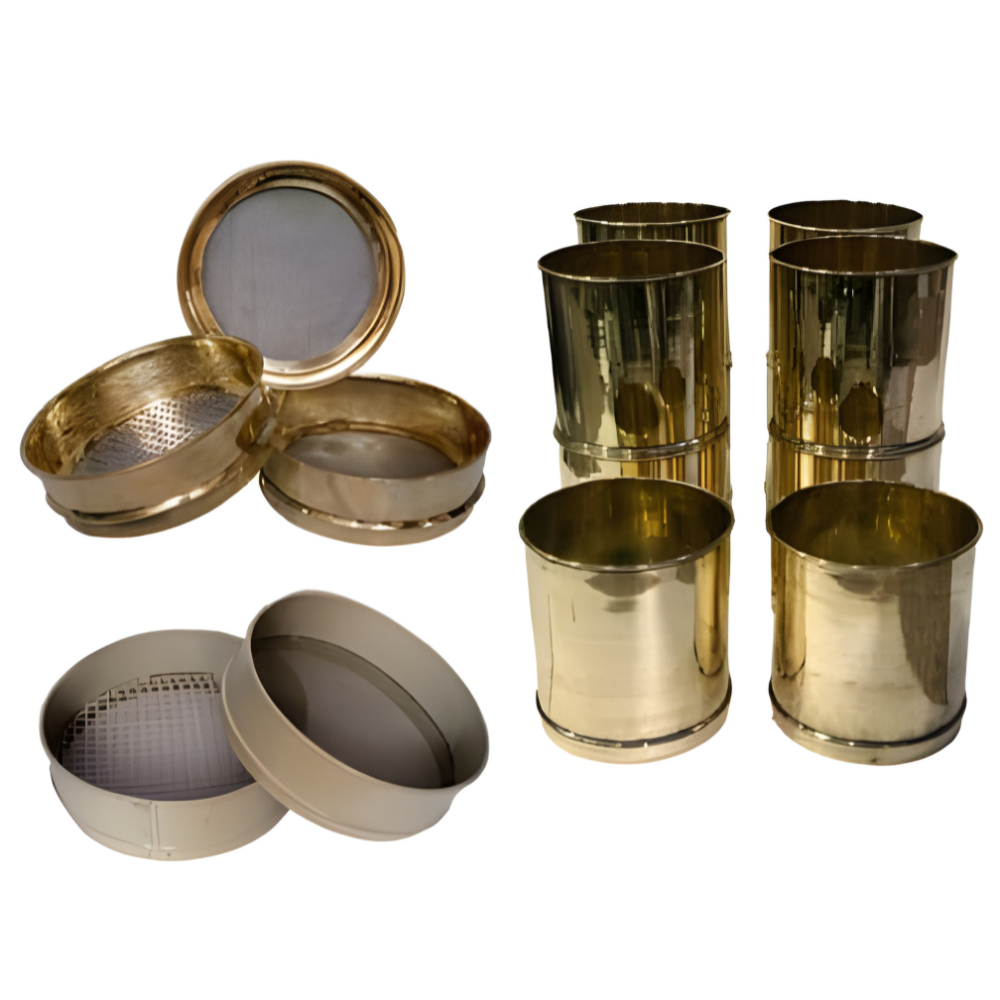
Types of Test Sieves
Different applications require different sieve types. The most commonly used Test Sieves include:
Stainless Steel Test Sieves
These are corrosion-resistant, durable, and ideal for laboratory applications requiring high precision.
Brass Frame Test Sieves
Brass frame sieves provide strength and are widely used in civil engineering laboratories.
Full Stainless Steel Test Sieves
Both the frame and mesh are manufactured using stainless steel, making them suitable for demanding industrial environments.
Perforated Plate Sieves
These sieves are used for larger particle sizes where woven wire mesh is not suitable.
Standard Test Sieve Sizes
Test Sieves are available in different diameters and mesh openings depending on testing requirements.
Common frame diameters include:
- 100 mm
- 150 mm
- 200 mm
- 300 mm
- 450 mm
Mesh openings range from coarse aggregates to extremely fine powders, allowing laboratories to perform a wide variety of particle size analyses.
Selecting the correct sieve size depends on the material being tested and the applicable testing standard.
Applications of Test Sieves
Test Sieves are widely used across several industries.
Soil Testing
Civil engineering laboratories use Test Sieves to determine soil gradation for foundation design, road construction, and geotechnical investigations.
Aggregate Testing
Aggregate grading directly affects the strength and durability of concrete. Test Sieves ensure aggregates meet specification requirements.
Cement Industry
Manufacturers use Test Sieves for quality control during cement production and laboratory testing.
Construction Industry
Contractors use sieve analysis to verify the quality of sand and aggregates before construction.
Mining Industry
Mining companies use Test Sieves for mineral classification and particle size separation.
Research Laboratories
Educational institutions and research organizations rely on Test Sieves for scientific experiments and material analysis.
How Does Sieve Analysis Work?
Sieve analysis is a standard laboratory procedure used to determine particle size distribution.
The basic process includes:
- Collect a representative material sample.
- Arrange Test Sieves from largest opening to smallest.
- Place the sample on the top sieve.
- Use a Sieve Shaker or manual shaking.
- Separate particles according to size.
- Measure the retained material on each sieve.
- Calculate the percentage retained and passing.
- Prepare the particle size distribution report.
This method provides valuable information for engineering design, quality control, and compliance with testing standards.
How to Choose the Right Test Sieve
Selecting the correct Test Sieve depends on several factors.
Material Type
Choose the sieve based on whether you are testing soil, aggregates, sand, cement, or minerals.
Standard Compliance
Ensure the sieve complies with IS, ASTM, ISO, or BS standards required by your project.
Frame Material
Stainless steel frames offer excellent corrosion resistance and long service life.
Mesh Accuracy
Always select precision-manufactured mesh to ensure reliable testing results.
Laboratory Requirements
Consider sieve diameter, mesh opening, and compatibility with your Sieve Shaker.
Maintenance Tips
Proper maintenance extends the life of Test Sieves and ensures accurate results.
- Clean the sieve after every test.
- Avoid damaging the wire mesh.
- Store sieves in a dry environment.
- Inspect mesh regularly for wear.
- Do not overload the sieve during testing.
- Use only appropriate cleaning brushes.
- Replace damaged sieves immediately.
Regular maintenance helps maintain testing accuracy and reduces replacement costs.
Why Choose Sethi Instruments?
Sethi Instruments has been a trusted manufacturer and exporter of laboratory testing equipment since 1985. We provide high-quality Test Sieves designed for precision, durability, and long-term performance.
Our Test Sieves are manufactured using premium-quality materials and undergo strict quality inspection before dispatch. They are suitable for civil engineering laboratories, universities, research institutions, contractors, infrastructure projects, and industrial quality control applications.
In addition to Test Sieves, we also manufacture Soil Testing Equipment, Sieve Shakers, Aggregate Testing Equipment, Cement Testing Equipment, Concrete Testing Equipment, Bitumen Testing Equipment, and other laboratory testing instruments.
Our commitment to quality, innovation, and customer satisfaction has made us a trusted partner for laboratories across India and international markets.
Frequently Asked Questions
Test Sieves are used to determine the particle size distribution of soil, aggregates, sand, cement, minerals, and other granular materials.
Construction, civil engineering, mining, research laboratories, educational institutions, pharmaceuticals, and material testing laboratories.
Sieve analysis is a laboratory method used to separate particles according to size using a stack of Test Sieves.
Most Test Sieves comply with IS, ASTM, ISO, and BS standards.
Replace a Test Sieve when the mesh is damaged, stretched, or no longer meets the required accuracy standards.
Conclusion
Test Sieves are indispensable tools for accurate particle size analysis and quality control across multiple industries. From soil and aggregate testing to cement and mining applications, they help ensure materials meet engineering standards and project requirements. By selecting high-quality Test Sieves, following proper testing procedures, and maintaining them regularly, laboratories can achieve reliable and repeatable results. Sethi Instruments is committed to providing precision-engineered Test Sieves and laboratory testing equipment that support dependable testing and long-term performance for civil engineering and construction professionals worldwide.
Explore Website:- https://sethiinstruments.com/
Visit Social Media
https://www.instagram.com/sethiinstruments
https://www.linkedin.com/in/sethiinstruments
https://www.youtube.com/@SethiInstruments
https://www.facebook.com/profile.php?id=61592602600713
Website:- https://sethiinstruments.com/
Follow US
https://www.instagram.com/sethiinstruments
https://www.linkedin.com/in/sethiinstruments
https://www.youtube.com/@SethiInstruments
https://www.facebook.com/profile.php?id=61592602600713
More Pages
https://sethi-instruments-3.jimdosite.com/
https://sand-pouring-cylinder-for-accurate-soil-density-a.jimdosite.com/
https://sethiinstruments.com/test-sieves-complete-guide/
https://sethiinstruments.com/sieve-shaker-guide/
https://sethiinstruments.com/riffle-sample-divider/
https://sethiinstruments.com/sand-pouring-cylinder/
https://in.pinterest.com/sethiinstruments/
https://in.pinterest.com/pin/1094304409484710107
https://in.pinterest.com/pin/1094304409484710169
https://soundcloud.com/sethi-instruments
https://soundcloud.com/sethi-instruments/riffle-sample-divider-for
https://soundcloud.com/sethi-instruments/sand-pouring-cylinder-for-in
https://soundcloud.com/sethi-instruments/sieve-shaker-for-accurate
https://medium.com/@SethiInstruments
https://medium.com/@SethiInstruments/test-sieves-manufacturer-india-faf33ec9aee4
https://medium.com/@SethiInstruments/sieve-shaker-manufacturer-in-india-0736c8bd54b3
https://www.tumblr.com/sethiinstruments/824303027072761856/understanding-sieve-shakers-for-reliable
https://www.tumblr.com/sethiinstruments/824303123623460864/test-sieves-manufacturer-in-india
https://sites.google.com/view/sandpouringcylinder/home
https://sites.google.com/view/testsievesforaccurate/home
https://sites.google.com/view/rifflesampledivider/home
https://www.yumpu.com/en/document/view/71263484/sand-pouring-cylinder
https://www.yumpu.com/en/document/view/71263484/sand-pouring-cylinder
Comments
Post a Comment